A persistent idea follows 6mm ARC around the internet: if the barrel is not 18 or 20 inches long, the cartridge is being wasted.
That is the wrong frame.
A longer barrel produces more velocity. That part is uncomplicated. What does not follow is the assumption that every 6mm ARC firearm therefore needs to be long, or that a compact 6mm ARC cannot retain the qualities that made the cartridge important.
Barrel length is not a test of commitment. It is a mission decision. The right length depends on whether the firearm will live on a static firing line or move through vehicles, structures, vegetation and constrained positions, possibly with a suppressor mounted.
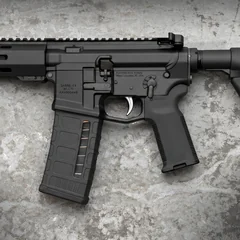
For SARC-6, Quadradyn selected a 12.5-inch architecture. Not because velocity is irrelevant, and not because 12.5 inches recreates a 20-inch barrel. It does neither. The selection preserves a substantial share of the cartridge’s velocity while making the complete system shorter, lighter at the muzzle and more manageable once suppressed.
It is a trade, not a miracle. It is also a compelling trade.
First, remove the powder myth
There is no technically defensible basis for saying “6mm ARC powder burns faster than .223 powder.”
Burn rate is a property of the selected propellant and the conditions in which it operates, not an inherent speed assigned to a cartridge name. SAAMI defines powder burning rate as the speed at which a propellant burns inside a cartridge case and notes that physical characteristics, chemistry and operating conditions affect it. Published data for 6mm ARC and .223 includes overlapping propellant families.
“Gas expands faster” is similarly incomplete. Pressure, gas generation, bullet mass, bore area, projectile travel and propellant characteristics interact through the internal-ballistic cycle. Without a defined measured quantity and test procedure, the phrase is marketing rather than engineering.
This correction does not weaken the short-barrel case. It clarifies it.
6mm ARC’s downrange advantage comes principally from launching long, aerodynamically efficient 6mm projectiles from a small-frame platform. A high ballistic coefficient helps the projectile conserve velocity after it leaves the muzzle. That retained velocity, not a claim of instantaneous powder consumption, is why the cartridge can give up some muzzle speed and remain useful at distance.
Ultra-compact 7.5- and 7.75-inch 5.56 systems provide a handling analogy, but nothing more. Their popularity shows that users accept substantial ballistic compromises when compactness matters. It does not prove that 7.75 inches is ideal for 5.56, nor establish anything about the 6mm ARC combustion cycle. The lesson is simpler: the shortest barrel is not automatically best, but neither is the longest.
What the published numbers show
Hornady’s pressure-compliant gas-gun data includes a barrel-length projection for 108- to 110-grain projectiles. The figures below use the higher-velocity side of that published table. Muzzle energy is calculated for a 108-grain projectile.
| Barrel | Published velocity | Calculated muzzle energy | Gain |
|---|---|---|---|
| 12 in. | 2,345 fps | 1,319 ft-lb | - |
| 14 in. | 2,430 fps | 1,416 ft-lb | +85 fps |
| 16 in. | 2,505 fps | 1,505 ft-lb | +75 fps |
| 18 in. | 2,575 fps | 1,591 ft-lb | +70 fps |
| 20 in. | 2,635 fps | 1,665 ft-lb | +60 fps |
| 24 in. | 2,740 fps | 1,801 ft-lb | +105 fps / 4 in. |
These are reference values from controlled load-development data, not guaranteed velocities for every firearm or every lot of factory ammunition. Chamber dimensions, bore condition, ammunition lot, temperature and instrumentation move the result. There is no universal “feet per second per inch” rule; a chronograph must establish what a particular firearm actually produces.
Interpolating the table places a 12.5-inch system near 2,365 fps. A responsible pre-validation expectation is therefore approximately 2,350 to 2,400 fps with a 108-grain match projectile. Quadradyn will replace the estimate with production SARC-6 chronograph data after a defined ammunition lot and test protocol are complete.
At the reference velocity, a 12.5-inch barrel retains roughly 90 percent of the modeled muzzle velocity of a 20-inch barrel while removing 7.5 inches from the firearm’s forward architecture. It does not retain 90 percent of muzzle energy: energy changes with the square of velocity. What it retains is the cartridge’s defining advantage: an efficient projectile that continues to conserve speed downrange.
What changes after the muzzle
Consider a representative model using a 108-grain match projectile with G7 ballistic coefficient approximately .270, launched at 2,350 fps. With a 100-yard zero, standard sea-level atmosphere and no wind, a conventional drag model gives the following approximate values:
| Distance | Velocity | Energy | Elevation correction |
|---|---|---|---|
| Muzzle | 2,350 fps | 1,325 ft-lb | - |
| 500 yd | ~1,640 fps | ~645 ft-lb | ~4 mil |
| 800 yd | ~1,280 fps | ~390 ft-lb | ~9 mil |
| 1,000 yd | ~1,090 fps | ~285 ft-lb | ~13–15 mil |
Those values are an analytical reference, not a firing solution. Actual data must use verified muzzle velocity, projectile-specific drag behavior, sight height, zero, density altitude, temperature and wind.
They also reveal the honest answer to the thousand-yard question. A 12.5-inch 6mm ARC can send a high-BC projectile to 1,000 yards, and a skilled shooter has a credible path to impacts there. But “can reach 1,000 yards,” “remains supersonic to 1,000 yards,” and “delivers dependable terminal performance at 1,000 yards” are three different claims.
At approximately 2,350 fps under standard sea-level conditions, the representative projectile is modeled to cross the speed of sound near 950 yards. A warmer, higher-altitude environment may extend supersonic flight beyond 1,000; dense air may shorten it. The projectile does not stop at Mach 1, but transonic passage can make the final portion less predictable.
SARC-6 is designed for legitimate thousand-yard target capability when ammunition, atmosphere, verified data and shooter are equal to the task, not universal supersonic or terminal performance.
Why not simply choose 20 inches?
For a dedicated bench rifle, competition rifle or unsuppressed long-range system, a longer barrel remains rational. It reduces required elevation, shortens time of flight, moderates wind-call difficulty and moves the transonic boundary outward.
SARC-6 has a different brief. A suppressor adds length and weight at the farthest point forward. That placement matters: muzzle weight changes balance and handling more than the same mass close to the shooter. Beginning at 12.5 inches preserves a compact overall envelope after suppression, reduces the complete system’s forward moment and makes movement through confined positions less cumbersome.
There is another side. A shorter barrel generally exposes a suppressor to greater muzzle pressure and thermal stress. SAAMI’s suppressor standard explicitly recognizes the relationship among cartridge, barrel length and muzzle pressure; its design-integrity procedure uses shortened barrels to create elevated test conditions.
“Suppressor ready” must therefore mean more than a threaded muzzle. The firearm, ammunition and suppressor must be evaluated as a system. Sound reduction does not eliminate the need for hearing protection, and a suppressor cannot restore velocity that never developed in the barrel.
Barrel length alone also does not guarantee accuracy. A 20-inch barrel is not automatically more precise than a properly made 12.5-inch barrel. The longer system’s velocity supplies a larger external-ballistic margin, while mechanical precision depends on barrel, chamber, ammunition, mounting interfaces and the behavior of the complete firearm.
The SARC-6 answer
Quadradyn did not select 12.5 inches because 20 inches “does not work.” We selected it because SARC-6 is intended to combine meaningful reach with carbine handling.
The architecture accepts a measurable velocity cost in exchange for a firearm that remains practical when suppressed. It retains the high-BC advantage that distinguishes 6mm ARC from conventional small-frame cartridges. It provides substantial performance inside the distances where compact carbines are most likely to be used, while preserving the ability to solve much longer shots when conditions permit.
The final authority will not be an internet rule. It will be production-gun chronograph data, verified trajectories and repeatable field results. Quadradyn will publish that data as validation is completed.
Twenty inches extracts more velocity from 6mm ARC. It does not define 6mm ARC. The mission defines the weapon.
For SARC-6, 12.5 inches is where reach and restraint meet.
Values are estimates for technical comparison, not firing solutions or guarantees of terminal effect. The downrange model assumes a 108-grain projectile, G7 BC .270, 2,350 fps, 100-yard zero, 2.6-inch sight height, standard sea-level atmosphere and zero wind. Individual firearms and ammunition lots must be chronographed and confirmed at distance. Firearm and suppressor configurations are subject to applicable law.
Technical source dossier
- Hornady: 108–110 grain 6mm ARC gas-gun data and barrel-length table.
- SAAMI: current centerfire-rifle standard.
- SAAMI glossary: powder burning rate.
- SAAMI glossary: over-bore capacity.
- Hodgdon: technical guidance on barrel length and chronograph validation.
- Hornady: ballistic calculators.
- SAAMI: firearm suppressor performance standard.