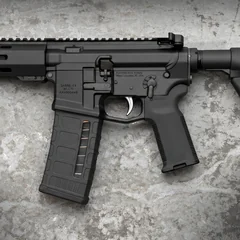
The gun that captured Maduro in the Delta Force Venezuela raid is now available to the public for the first time. Quadradyn officially launched the first ICAR-magazine compatible 6 ARC firearm to the public in September of 2026. It is called the SARC-6, it is built in Pompano Beach, Florida, and it ships to your FFL.
That sentence needs unpacking, because the words in it are doing a lot of work. “ICAR” is a SureFire trademark, and SureFire’s rifle is still not something you can buy. What the public can buy now, for the first time, is a complete rifle built on the same wide magazine well, feeding from the same Magpul magazine, chambered in the same cartridge. The receiver pattern that let the Unit finally run 6mm ARC without babying it is no longer a government-only configuration. Here is how it got here.
What Quadradyn launched, exactly
The SARC-6 is a 12.5-inch 6mm ARC carbine on a receiver set cut for the Magpul PMAG 25 ICAR magazine. We buy the receiver set from Palmetto State Armory, the Sabre-IC, then modify it before it goes into a rifle. Everything forward of the receiver and inside it is our decision: the barrel steel, the gas block strategy, the bolt, the trigger, the carrier, the buffer system, and the gauge-based inspection every rifle passes before it leaves. Two barrel configurations are in stock now.
We are careful about one thing in every sentence on this site, and it matters enough to say up front: the SARC-6 is not an ICAR. ICAR is SureFire’s name for SureFire’s rifle. The SARC-6 is an ICAR-magazine compatible 6 ARC rifle. If that sounds like lawyer talk, it is, and section six explains why.
Why 6 ARC exists
Every intermediate cartridge story starts with the same complaint: 5.56 runs out of steam. It is light, it is controllable, and past 500 yards it is a coin flip in the wind. The traditional answer was a bigger gun, a .308-frame AR-10 that solves the distance problem by adding three pounds and a recoil impulse that slows down everything you do up close.
The people who eventually asked Hornady for a new cartridge did not want a bigger gun. On the Hornady Podcast, Hornady’s Miles Neville described the request as he remembered it: they did not want a full-fledged large-frame AR, they wanted to reach .308-class terminal performance or better, and keep it in a small frame. 5.56 did not have the horsepower. 6.5 Grendel got close, but its projectiles were, in his words, too much bullet for the case. A properly designed 6mm projectile could do it: at 105 to 108 grains, a long, aerodynamically efficient 6mm bullet gives up drag to a comparable 6.5, and that efficiency is the whole point.
Shooting Times reported the same origin from the customer side. Special Operations Command wanted more range and lethality than a 5.56 AR without a large-frame .308 platform. They looked at 6.5 Grendel first. Hornady proposed building a cartridge tailored to the requirement instead.
“The 6mm ARC does much of what larger cartridges can and everything that smaller cartridges can’t.”Jayden Quinlan, Hornady ballistician, June 3, 2020 press release
Hornady’s cartridge
Hornady announced the 6mm Advanced Rifle Cartridge on June 3, 2020, and said in the same release that it had already been “tested, selected and fielded by a specialized group within the U.S. Department of Defense for its multipurpose combat rifle program.” Jayden Quinlan, the ballistician who conceptualized it, framed the design question simply: what can today’s technology do to maximize the performance of the AR-15 platform?
The answer was a third-generation descendant of the 7.62×39 case. Hornady took the 6.5 Grendel case, necked it down to .243, and moved the 30-degree shoulder back about .030 inch so its long ELD bullets could be seated without blowing past the 2.260-inch magazine length of an AR-15. The case head stayed at .441 inch, the same as Grendel, so a Grendel bolt face works. Launch loads were a 105-grain BTHP, a 108-grain ELD Match and a 103-grain ELD-X. Hornady’s own claim at launch was .308-comparable performance at 30 percent less ammunition weight.
The first military rifles followed the cartridge out the door. Barrett delivered REC7 rifles in 6mm ARC to the Department of Defense in June 2020. Geissele’s Freedom Rifle became the first rifle SOCOM chose for the cartridge, and according to Shooting Times it went through a testing cycle most civilian makers never see: ten sample rifles, 50,000 rounds each, every malfunction documented. Geissele spent two years iterating a stainless steel magazine for it, and worked with Carpenter Technology on a cleaner bolt steel because the bolt was where 6 ARC broke.
Quadradyn has written about the cartridge’s exterior ballistics before. FILE-004 covers what a 12.5-inch barrel actually gives up and keeps. This file is about the other half of the problem: feeding it.
The magazine problem
6 ARC sold itself on a promise: drop it into an AR-15 with a barrel, bolt and magazine swap, like .300 Blackout. In practice the cartridge broke three of the AR-15’s rules at once, and the platform never fully forgave it.
First, the bolt. A .441-inch case head in a bolt sized for a .378-inch 5.56 head leaves very little steel in the locking lugs. Grendel shooters had reported sheared lugs for a decade before 6 ARC arrived, and 6 ARC ran at higher pressure. Enhanced bolts, shot-peened, re-melted steels, and adjustable gas blocks pushed the failures out, but the margin was always thin. Forum threads about bolts cracking under 2,000 rounds are not hard to find.
Second, and worse, the magazine. The fat case does not stack properly inside a magazine that has to fit a 5.56 magazine well. It sits in a lazy stagger, the round on top presents at a bad angle, and the follower struggles to keep up at speed. The best-known workaround was a 19-round metal magazine that was never designed for the round in the first place. Brass Facts, whose August 2026 video “ICAR is here” is the most honest civilian take on the platform we have seen, put it bluntly: 6 ARC in an AR-15 had earned a reputation as a finicky, unreliable piece of, well, you can watch the video. Geissele’s purpose-built steel magazines fixed the feeding and cost more than a hundred dollars each.
You cannot get a true double stack of 6 ARC inside an AR-15 magazine well. Every other fix was a workaround for that one geometric fact.
Third, the platform. Each fix pulled the rifle a little further from the AR-15 standard anyway: a special bolt, a special magazine, a tuned gas system. By the time a 6 ARC AR-15 ran reliably, most of the parts that mattered were already proprietary. The obvious question followed. If the magazine well has to change, why not change it properly?
Someone had already done that, fourteen years earlier, for a different cartridge. Around 2012, LWRC International won a large Saudi contract for rifles in 6.8 SPC and partnered with Magpul to build a PMAG around the fatter 6.8 case. Rather than force the magazine into a standard lower, LWRC molded the Six8 receivers around the magazine: an enlarged magazine well with a flared entry and an over-insertion stop. Magpul kept making the Six8 magazine long after the contract. That footprint is where the modern story picks up.
SureFire’s ICAR
SureFire is better known for flashlights and suppressors than rifles, but the company has been building complete weapons for government customers for years, and the ICAR was not an overnight project. On the Hornady Podcast, SureFire’s Andrew Wright said the program had been running in the background for well over ten, close to fifteen years through different iterations. He called it the improved carbine, a full rifle system driven by specific customers with specific problems to solve. Trade press spells the acronym out as Intermediate Combat Assault Rifle, intermediate because 6mm ARC sits between 5.56 and 7.62 in range and energy.
The 6 ARC chambering was, by his account, customer-driven. And the customers did not want another 5.56-envelope compromise. Wright was specific about what changed: originally everybody wanted the rifle to fit normal 5.56 AR dimensions, but SureFire saw shortcomings on the feeding side, so the ICAR is slightly bigger. They worked with Magpul to develop a magazine that fits 6 ARC and feeds it reliably. Externally the difference is hard to notice; internally it is enough room for a proper cartridge stack.
Soldier Systems Daily reported the sequence. Magpul announced the PMAG 25 ICAR GEN M3 Window on January 17, 2025, describing it as an evolution of its 2012 Six8 28-round magazine: SureFire had developed an enlarged magwell based on the Six8 pattern, custom-broached test magazines to 6 ARC dimensions, and then handed Magpul the job of making a production magazine. The end user asked for a slightly shorter magazine than the Six8, which is why it holds 25 rounds and still fits a standard 30-round pouch. A week later, on January 25, Soldier Systems photographed the preproduction ICAR itself: a prototype first fired in late November 2024, built for a government customer, with commercial sales planned but not yet authorized. “This is a whole new gun,” the report said of the upper and lower, both redesigned around the cartridge.
How well does it work? At a Hornady media event at the Hat Creek training facility, by Miles Neville’s count, fifteen 6 ARC ICARs went through a few thousand rounds over three days, uphill and downhill, out to 850 or 900 meters from 16-inch guns, without a single malfunction he witnessed. Anyone who has run a line of fifteen semi-auto rifles at a media event, in any caliber, knows how unusual that is.
Then it went to work. On January 3, 2026, Delta Force and the 160th Special Operations Aviation Regiment captured Nicolás Maduro in Caracas in Operation Absolute Resolve. Images and posts that circulated afterward, including from retired Delta operator Larry Vickers, identified the SureFire ICAR in 6mm ARC as the assaulters’ rifle. On July 12, 2026, Special Ops Magazine published what it called the first images of Delta Force using the ICAR with a SureFire suppressor, and noted the rifle was reportedly used during the Maduro raid. The Department of Defense does not publish load-outs and it has not confirmed this one. We treat the reporting as credible and widely corroborated, and we do not treat it as an endorsement of anything we build.
Delta is photographed with SureFire’s rifle. SEAL Team Six’s move to 6 ARC is documented through the Geissele program. The cartridge is in both units, and the wide-magwell pattern is where the cartridge is going.
What is in a SureFire ICAR that is not in a standard AR? The parts you can see and the parts you cannot. The receivers are wider and the ejection port is enlarged. AR15.com members picking apart the preproduction photos noticed the upper tapers ahead of the ejection port, which makes sense if SureFire is using a larger barrel nut or barrel extension to go with a larger-diameter bolt. The bolt is the point. One commenter on the Soldier Systems story described the ICAR bolt face as more robust than an AR Grendel bolt face, a complete redesign rather than a simple enlargement. Another AR15.com poster made the sharper observation: the Six8 bolt was the same size as a standard bolt, so whatever SureFire did to the bolt is something separate from the magwell. Trade coverage adds a SureFire-style optimized bolt carrier, the OBC design that lengthens dwell and slows initial bolt velocity, and a fully ambidextrous lower. As Brass Facts noted, you cannot buy the ICAR bolt and carrier, which brings us to the part everyone else has to solve for themselves.
Who owns the name
SureFire, LLC filed to register ICAR as a trademark for “rifles” with the United States Patent and Trademark Office on April 26, 2023, on an intent-to-use basis, serial number 97909120, international class 13. The USPTO published it for opposition on June 4, 2024. SureFire filed its statement of use on January 29, 2025, twelve days after Magpul’s magazine announcement, and the mark registered on the Principal Register on May 13, 2025. SureFire owns the word.
Magpul sells the PMAG 25 ICAR with a trademark symbol after ICAR and describes it as built for “the 6mm ARC Surefire® ICAR carbine and other firearms with a mag well based on the LWRCI Six8 lower receiver.” That is the plainest statement of the pattern anyone has published: the magazine defines the pattern, and the pattern is the Six8 magwell.
Palmetto State Armory, the second company to sell the pattern, did not call its receivers ICAR. It called them Sabre-IC, and it sells them bundled with Magpul PMAG 25 ICAR magazines, using Magpul’s name for Magpul’s product. We believe SureFire licensed the mark for PSA’s use in that context; we have not seen the paperwork and we are not going to guess at its terms. What we can see from the outside is a company that makes the receivers being careful about the word, and a magazine maker using the word with the trademark symbol attached.
So Quadradyn is careful too. The SARC-6 is an ICAR-magazine compatible 6 ARC rifle. It takes the Magpul PMAG 25 ICAR. It is not an ICAR, it is not a SureFire product, and the name on the receiver is ours.
PSA’s receivers
At SHOT Show in January 2026, Palmetto State Armory announced that its Sabre 6 ARC rifles and its Mix Tape Vol. 2 would move to ICAR-pattern receivers. The Truth About Guns reported the reasoning the way PSA framed it: the SureFire ICAR had generated significant industry buzz, SureFire did not appear to be planning a civilian release any time soon, and the dedicated receiver set allows a more durable bolt capable of handling higher-pressure 6 ARC loads. The receivers reached market on June 12, 2026, as the Sabre-IC ambidextrous receiver set: forged 7075-T6, flared ICAR-pattern magwell with an integral trigger guard, pre-installed ambidextrous bolt catch and release, thermal-fit upper with engraved T-marks, $329 in black or $349 in Cerakote, $499 with five PMAGs. Complete PSA rifles were shown at SHOT; as of this writing the parts have beaten the guns to market.
Here is the technical distinction that matters, and the one the enthusiast community worked out first. The PSA receivers are, in Brass Facts’ phrase, an ICAR light. PSA changed the magazine well and the upper’s dimensions to match. It did not change the bolt or the carrier. The Sabre-IC upper takes standard 6 ARC bolts and carriers, and PSA’s own compatibility notes say the set works with mil-spec triggers, safeties, pins and charging handles. SureFire, by contrast, redesigned the bolt and carrier around the cartridge and does not sell them. That difference is the whole ballgame for a builder, because it means the reinforced bolt is still your problem to solve on a PSA receiver, and it is still the historic failure point of the cartridge.
| Feature | Standard AR-15 in 6 ARC | SureFire ICAR | PSA Sabre-IC set | Quadradyn SARC-6 |
|---|---|---|---|---|
| Magazine | Modified AR-15 mags, no true double stack | Magpul PMAG 25 ICAR | Magpul PMAG 25 ICAR | Magpul PMAG 25 ICAR |
| Magwell | 5.56 envelope | Enlarged, Six8-based | Enlarged, flared, ICAR pattern | Enlarged, ICAR-magazine pattern, Quadradyn-modified |
| Bolt | Grendel-face bolt, thin lugs | Proprietary redesign, not sold | Standard 6 ARC bolt (builder’s choice) | Thicker-rim bolt on both builds |
| Carrier | Standard | SureFire OBC-style, not sold | Standard | Full-profile, hard-chromed, tuned H2 system |
| Availability | Yes | Government only, no civilian date | Receiver set only | Complete rifle, in stock |
Two more quirks of the pattern, both reported by owners rather than manufacturers. You cannot hot-swap an existing 6 ARC upper onto a Sabre-IC lower; the pins line up, the magazine will not seat. And because the upper’s front face changed, handguards with anti-rotation tabs that overlap the upper will not fit without modification. PSA says so on its product pages, and Brass Facts learned it with a Dremel. Those are not defects. They are what it looks like when a platform stops pretending to be an AR-15 and becomes, as the community has started calling it, a medium-frame AR.
Reliability is the reason to accept all of that. In Brass Facts’ 800-round test on a PSA receiver set, with a lot of dust in the magazine and some high cyclic use, he recorded zero magazine-induced malfunctions. His rifle had other problems, from a parts-bin barrel and gas block he cheerfully declined to diagnose, but the magazine and magwell did the one thing 6 ARC in an AR-15 never reliably did.
What Quadradyn changed
We looked at the same landscape everyone else did in the summer of 2026: a cartridge SOCOM has already committed to, a magazine that finally solves it, a receiver set on the market, and no complete rifle anyone outside the government could buy. We decided the configuration Delta Force and SEAL Team Six carry should be available to the American public, built by a licensed manufacturer that gauges every rifle before release rather than as a parts-bin project.
So the SARC-6 starts with the PSA receiver set, and it does not end there. We modify the receiver set to our own print before it is built into a rifle; we are not publishing the changes. And the receiver set is a small part of an overall firearm. What makes the SARC-6 a Quadradyn rifle is everything else:
- BarrelTwo 12.5-inch, 1:7-twist 6mm ARC barrels: precision stainless for the most accuracy the platform can give, or chrome-moly vanadium for heat and round count. FILE-004 explains the length.
- Gas blockClamp-on adjustable on the stainless build to maximize accuracy; dual set-screw and chemically pinned adjustable on the CMV build (the SARC-6 Tactical) to ensure less movement under hard use.
- BoltOn both builds, a bolt with a thicker bolt-face rim for high pressure loads and extended life, our answer to the cartridge’s oldest weakness on a receiver that does not include SureFire’s bolt.
- Operating systemFull-profile hard-chromed carrier, chrome-silicon spring, H2 buffer, gas-mitigating ambidextrous charging handle, 11.5-inch suppressor-ready M-LOK handguard (11.7-inch on the SARC-6 Tactical) fitted to the ICAR-pattern upper.
- FinishDuraveil, our proprietary Cerakote technique, on the SARC-6 Tactical: invisible to infrared on the outside, extremely slick and easy to clean on the inside.
- ReleaseEvery rifle passes a written, gauge-based inspection plan: headspace, bolt and carrier relationships, gas interfaces, feed geometry, control function. Then it ships to your FFL, in 5-6 days for the SARC-6 and 2-3 weeks for the SARC-6 Tactical.
The gun that captured Maduro is available to the public for the first time. Not SureFire’s rifle, which you still cannot buy, but the configuration that made it work: the cartridge, the magazine, the magwell that finally fits it, and a bolt built to survive it, assembled and gauged in Florida under a Type 07 license. Quadradyn officially launched the first ICAR-magazine compatible 6 ARC firearm to the public in September of 2026. It is called the SARC-6.
The gun that captured Maduro is built around a magazine you could not buy a rifle for. As of September 2026, you can: the SARC-6 is the first ICAR-magazine compatible 6 ARC firearm sold to the public.
Company statements are attributed to the company. Unit-level claims about the January 2026 operation rest on post-operation images and posts, including from Larry Vickers, and on Special Ops Magazine’s July 2026 photographs; no government agency has confirmed the load-out. Technical comparisons of the SureFire and PSA receivers rely on manufacturer statements, trade reporting, and owner reporting on AR15.com and in Brass Facts’ August 2026 video; Quadradyn has not disassembled a SureFire ICAR. Reporting status: September 6, 2026. ICAR is a registered trademark of SureFire, LLC; PMAG is a trademark of Magpul Industries; Sabre is a trademark of Palmetto State Armory. Quadradyn is not affiliated with any of them.
Source dossier
- Hornady: “Hornady Introduces the 6mm ARC”, June 3, 2020.
- 6mm ARC: case lineage, dimensions and SAAMI/C.I.P. pressure standards.
- Shooting Times: “The Geissele Freedom Rifle in 6mm ARC”, SOCOM origin, testing, magazines and bolt steel.
- The Hornady Podcast: episode with SureFire’s Andrew Wright and Hornady’s Miles Neville, ICAR program history, Magpul magazine, Hat Creek event.
- Soldier Systems Daily: “Magpul Releases PMAG for SureFire ICAR 6 ARC”, January 17, 2025.
- Soldier Systems Daily: “SureFire ICAR 6ARC Preproduction Carbine”, January 25, 2025.
- Magpul: PMAG 25 ICAR GEN M3 Window (MAG1490), compatibility statement.
- AR15.com: “Surefire ICAR carbine” discussion thread, January–February 2025.
- USPTO serial 97909120: ICAR, SureFire, LLC, filed April 26, 2023; registered May 13, 2025.
- Athlon Outdoors: LWRC Six8 and the Magpul 6.8 PMAG partnership.
- The Truth About Guns: “PSA Adopts ICAR Pattern for New 6 ARC Rifles”, January 2026.
- The Firearm Blog: “PSA Offers Sabre-IC Receiver Sets For 6mm ARC”, June 2026.
- Palmetto State Armory: Sabre-IC Ambi Receiver Set, specifications and handguard compatibility note.
- Brass Facts: “ICAR is here”, August 2026, PSA receiver test and platform analysis.
- DFC Arms: “ICAR Pattern Rifles and Receivers to Watch”, January 2026, Barrett REC7 delivery and pattern overview.
- The Washington Post: inside the raid that captured Maduro, January 3, 2026.
- Task & Purpose: Delta Force and the 160th SOAR carried out the Venezuela raid.
- Special Ops Magazine: first images of Delta Force with the SureFire ICAR, July 12, 2026.
- Larry Vickers: on the SureFire ICAR in 6mm ARC.
- Gun Talk: SureFire SHOT Show 2026 launches, SOCOM6-MINI4 suppressor.